

Lidocaine HCl Products Across Different Dosage Forms
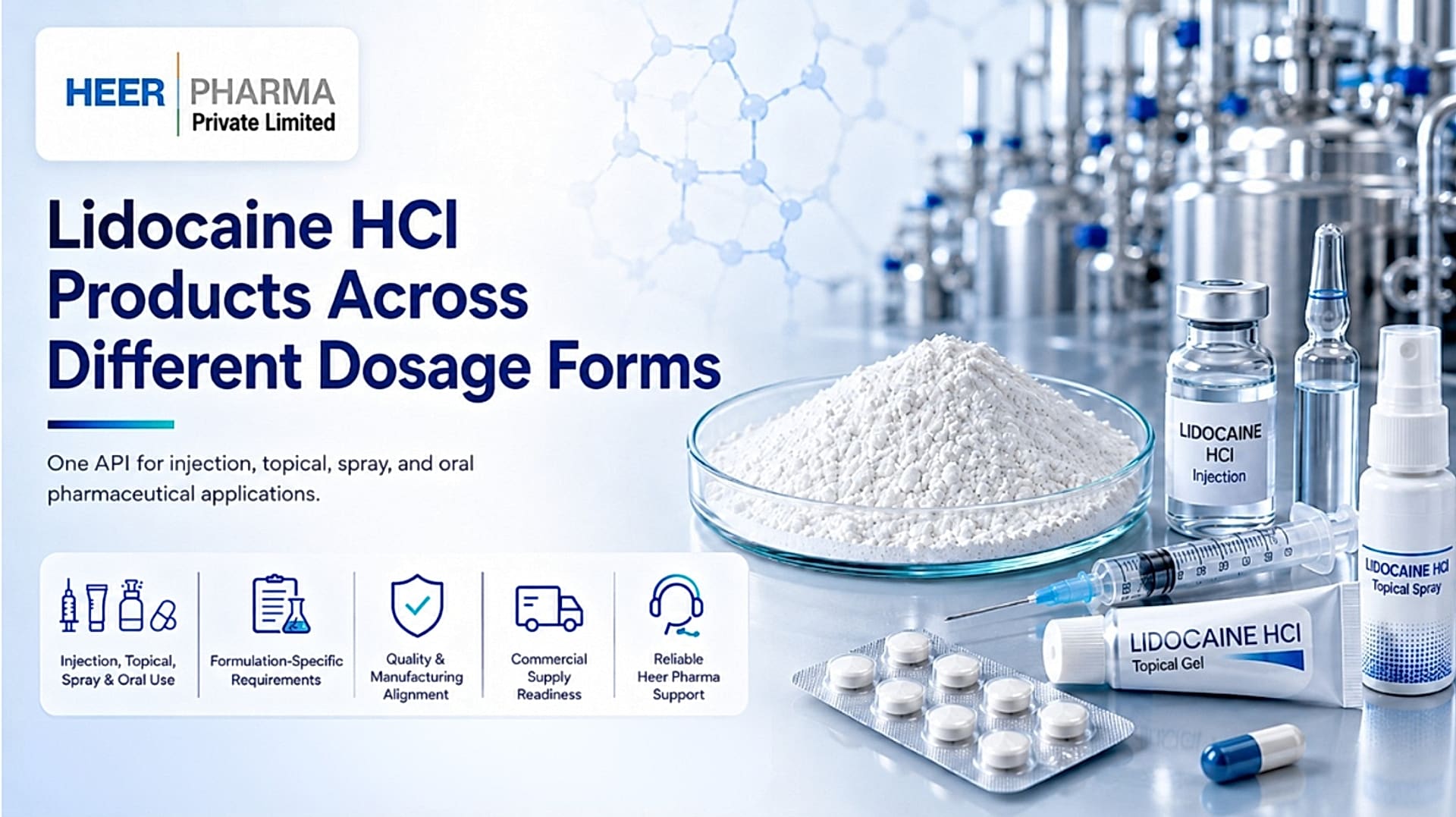
A pharmaceutical ingredient in its raw form is simply a starting point. It only becomes meaningful when formulated into a finished product.
A pharmaceutical ingredient in its raw form is simply a starting point. It only becomes meaningful when formulated into a finished product.
When an active ingredient is used across multiple product categories, the raw material itself remains largely the same.
Yet the technical expectations placed upon it change entirely depending on the finished product. What begins as a shared chemical compound eventually splits into very different manufacturing realities.
The molecule serves the product. The product dictates what matters.
One Molecule, Different Product Worlds
Lidocaine HCl is not a single-product material. It routinely moves into entirely different manufacturing streams, serving as a foundational ingredient across a wide spectrum of human pharmaceutical applications.
One delivery of material might be destined for an aseptic processing line. Another might be routed to a high-shear mixer for a semi-solid batch.
In each of these scenarios, the molecule is identical. The commercial realities surrounding it are not.
The way a material is evaluated and handled for a Lidocaine HCl Injection is fundamentally different from how it is viewed when intended for a topical gel or an oral preparation. The final product defines the priorities, and development teams approach the API based on the specific world it is about to enter.
Dosage Forms Create Different Expectations
A dosage form is essentially a delivery environment, and each environment asks different things of the active ingredient.
When formulating Lidocaine HCl Topical Formulations, development teams are looking at entirely different variables than a team working on an aqueous solution. In practice, formulation scientists must anticipate how the material behaves within specific formats:
Creams and gels create different expectations around texture and everyday use.
Sprays introduce their own handling and delivery requirements.
Liquid products operate within entirely different physical environments than semi-solid systems.
In every case, reviewing Lidocaine HCl API Specifications is just the baseline. What matters next is how the material aligns with the specific physical demands of the intended delivery format.
Whether evaluating a new compound or expanding an existing API Range, formulators have to anticipate the physical realities of the final product.
Formulation Systems Shape the Finished Product
Moving a compound into a finished product means introducing it to a system of excipients, carriers, and vehicles.
Once the active ingredient enters a finished formulation, it becomes only one part of a much larger system. At that point, excipients, carriers, and vehicles begin shaping the product just as much as the molecule itself.
Establishing practical Lidocaine HCl Quality Parameters early in development helps formulation teams understand how the material fits within the larger system they are building.
A formulation may appear promising during development, but it ultimately has to function within the realities of the finished product throughout its commercial life.
The active ingredient does not operate in isolation; it simply serves that broader formulation system.
Commercial Manufacturing Looks Different Across Products
Scaling a product from development to routine commercial manufacturing highlights the differences between dosage forms very quickly.
The infrastructure required to produce sterile solutions operates under entirely different constraints than a facility compounding bulk semi-solids. Depending on the final product, production managers face completely different operational realities regarding:
Batch sizes and scale-up limitations
Processing equipment constraints
The daily pace of continuous production
As products move into routine supply, procurement teams look at the supply chain through the lens of their specific manufacturing reality.
Sourcing from capable Active Pharmaceutical Ingredient Manufacturers in India becomes a matter of matching the raw material supply to the operational rhythm of the facility.
For companies working with global Pharmaceutical API Manufacturers in India, the conversation naturally centers on continuity, precise documentation, and long-term manufacturing predictability.
Supporting Human Pharmaceutical Products
Moving a pharmaceutical product from early development into routine manufacturing requires coordination across multiple technical and operational functions.
Based in India, Heer Pharma works with companies managing product development and commercial manufacturing across a wide variety of dosage forms.
Whether a team is evaluating a new Lidocaine HCl Manufacturer India for a specific pipeline project or seeking an experienced Lidocaine HCl Supplier India to support established commercial lines, the focus remains on aligning raw material sourcing with actual manufacturing requirements.
For additional information or specific product inquiries, companies can connect with Heer Pharma.