

Amisulpride API Manufacturers in India: Quality, Applications and Procurement Guide
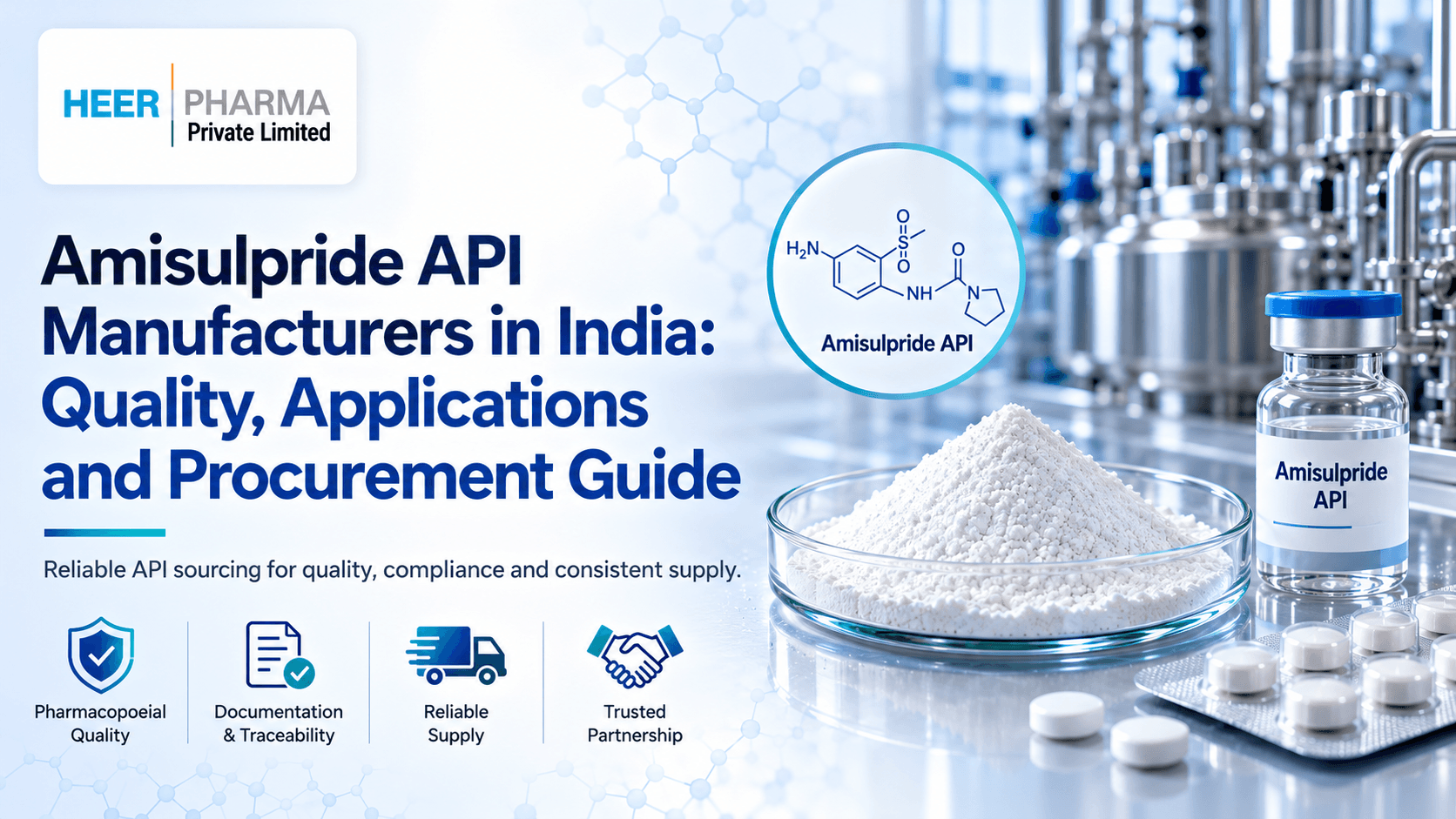
Learn how to choose Amisulpride API manufacturers in India by evaluating quality standards, specifications, regulatory documents, and procurement requirements.
Finding a company that lists amisulpride on its website is the easy part. Before you place an order with any of the amisulpride API manufacturers in India, you need to know who actually makes the material, what specification it's tested against, which documents ship with it, and which market the finished product is headed for. What passes in one market can fall short in another, and the paperwork usually changes with it.
Understanding Amisulpride API and Its Applications
Amisulpride is a substituted benzamide that blocks dopamine D2 and D3 receptors. What it's approved for depends on where you are and which dosage form you mean. In the US it's an intravenous injection for postoperative nausea and vomiting. In a number of other countries it's marketed as an oral medicine for psychiatric use.
If you're a manufacturer, this is the active ingredient that goes into your finished product. Pin down the specification before you buy. It depends on what you're making and where you'll sell it, and it's a lot harder to sort out once the order is in.
Quality Checks for Amisulpride Pharmaceutical API
Start with the standard the material is tested against. Amisulpride has a Ph. Eur. monograph, and because the BP reproduces the Ph. Eur. texts, BP-referenced material is held to the same requirements. Some Indian suppliers quote the Indian Pharmacopoeia instead. Which one you need depends on your product and target market, so check the current edition and read it against the supplier's actual test list. You'd normally expect to see identity, assay, related substances, residual solvents, loss on drying and sulfated ash on it.
Confirm the stereochemical form : Amisulpride has a chiral centre, and the Ph. Eur. treats the substance as the racemate. The S-enantiomer is a separate compound in its own right, not just another grade of the same API. So read the paperwork closely. The chemical name, the CAS number (71675-85-9 for racemic amisulpride) and the stereochemical description should match across the CoA, the specification and your own dossier. Supplier pages often disagree with one another on this, and it's easier to catch before an order than after.
Ask about the solid form : Amisulpride is known to exist in at least two polymorphic forms. Form I is the more thermodynamically stable, while the metastable Form II absorbs less moisture and dissolves more readily. Whichever form your formulation is built around, ask the supplier which one they supply, how they confirm it (XRPD or DSC, for example) and how they keep it consistent from batch to batch. It matters most if your dissolution profile or moisture handling is sensitive to the solid form.
Check how related substances are tested : The monograph controls related substances by liquid chromatography, and EDQM supplies an "amisulpride for system suitability" reference standard for that test. If a supplier runs an in-house method instead, ask for the validation data and how its results compare with the monograph method.
A batch CoA should show the batch number, specification, tests performed, acceptance criteria and results. But the CoA alone isn't enough. The documents should also let you identify the original manufacturing source and trace the batch back through the supply chain. ICH Q7 is a useful reference here, since it covers supplier evaluation, buying against agreed specifications and how much weight to give a supplier-issued CoA.
Regulatory documents depend on where you're selling : Buyers may ask for a DMF, a CEP or other regulatory documentation. Ask which ones the supplier holds, and confirm they cover the site and the substance you're buying.
If the API is for a human medicine and will be imported into the EU from India, a written confirmation from the exporting country's regulator is required under Article 46b(2)(b) of Directive 2001/83/EC. In India, CDSCO issues it. India isn't on the European Commission's list of countries exempt from this requirement. The confirmation is issued per manufacturing site and active substance, the issuing authority sets its validity, and a copy has to accompany each consignment. An EDQM inspection doesn't replace it, and Member States can waive it only in exceptional cases to protect supply. Check that the site, the substance and the validity date on the document match what you're buying.
Evaluating Amisulpride API Manufacturers in India
Start with a basic question: is this company an actual amisulpride manufacturer in India, or a supplier offering material made somewhere else? The market includes manufacturers, traders and distributors, and any of them can be a legitimate source. What matters is knowing which one you're dealing with. Capacity and certification details on supplier pages are usually the supplier's own statements, so ask for supporting documents such as manufacturing licences, GMP certificates and audit reports. If an intermediary is involved, you should still be able to identify the original manufacturing site.
After that, look at analytical capability, batch consistency, packaging controls and export experience. Ask directly:
Amisulpride Bulk API: Procurement and RFQs
For amisulpride bulk API, price is only part of the picture. Lead time, packaging format and how quickly the documents arrive matter just as much. A clear enquiry also saves a round of emails. State the specification, quantity, destination country, packaging, documents needed and delivery date, so the supplier can quote against something specific.
Amisulpride API Sourcing with Heer Pharma
Heer Pharma helps pharmaceutical companies with API sourcing and supply. It coordinates with suitable producers and works with buyers to understand their product requirements. Amisulpride is part of its API range.
Depending on what the buyer needs, that can include specification matching, documentation coordination, commercial communication and supply-chain coordination, including third-party sourcing. The original manufacturer remains the producing site named in the documentation.
To request a quotation, share your specification, estimated quantity, destination market, packaging preference, documentation needs and delivery schedule. Heer Pharma can then review the details and coordinate suitable sourcing options.
Conclusion
Sourcing amisulpride API isn't just about price and availability. The specification, stereochemical form, solid form, batch documentation, original manufacturing source, traceability, regulatory requirements and supply terms all belong in your qualification file. Settle them before you ask for quotations, and comparing suppliers gets much easier.
- What are the typical batch capacity and minimum order quantity?
- What is the normal lead time?
- Is there a backup manufacturing source if the primary site is unavailable?
- How are manufacturing changes communicated to buyers?
- Can the supplier support repeat commercial batches, and higher demand after launch?